

In the field of automotive safety and the development of driver assistance systems, one of the major challenges is to better take into account actual traffic conditions. Systems such as Adaptive Cruise Control adjust speed and distance from the vehicle in front, but their effectiveness is limited when they do not have accurate information about road or tyre conditions. However, these parameters directly influence grip and therefore braking distance, particularly on wet or damaged roads.
Current assistance systems operate mainly on the basis of kinematic data and conventional sensors, without integrating essential elements such as tyre wear, tyre type or ground weather conditions. This lack of information reduces the accuracy of braking distance calculations and can lead to delayed reactions in critical situations. In the context of autonomous vehicles, this limitation becomes even more problematic, as fine-tuning speed and braking relies on a reliable estimate of the vehicle’s grip potential.
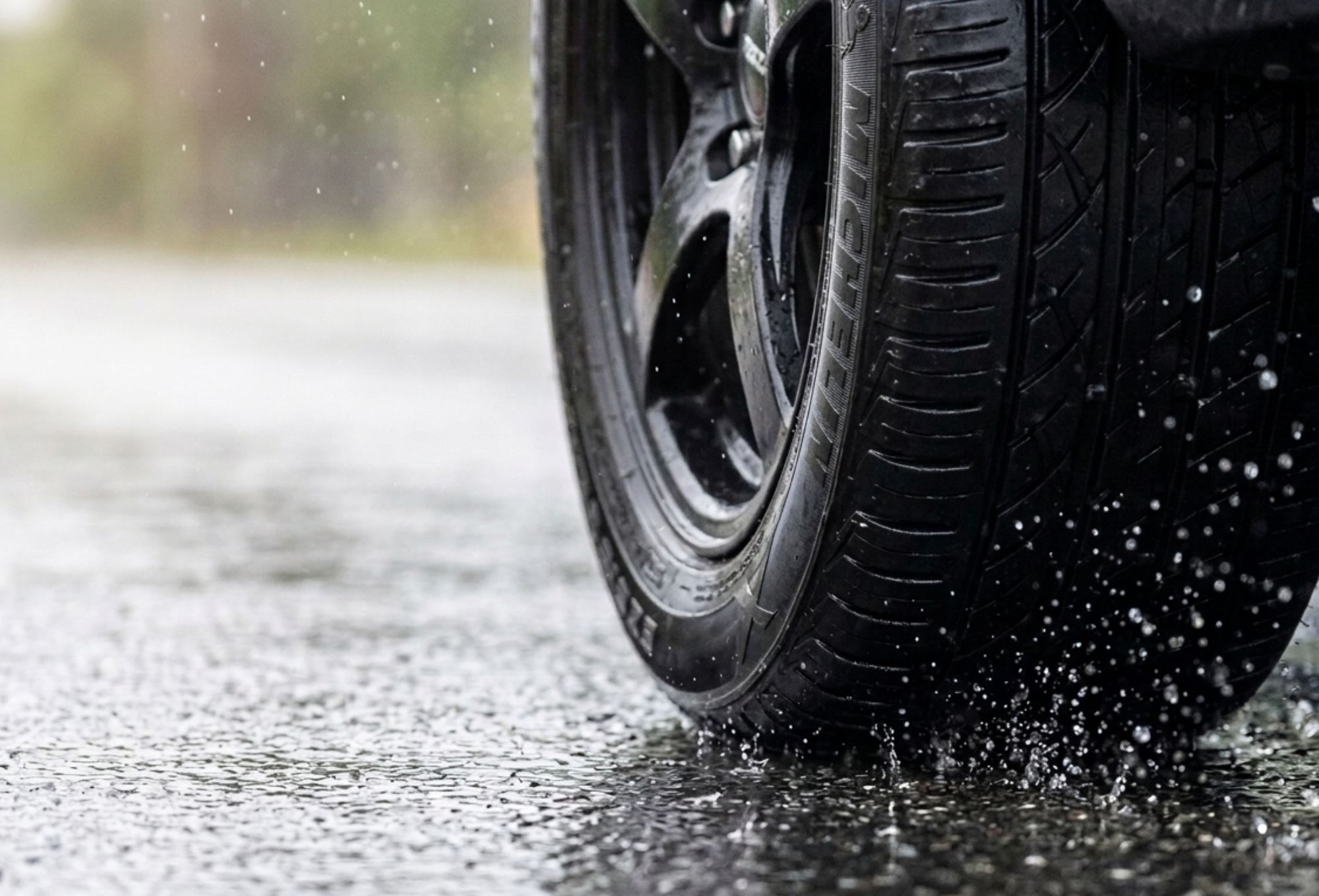
To address these challenges, mRT has developed an innovative approach based on acoustic analysis of tyre rolling noise. By capturing sound signals directly at the tyre-road interface using on-board microphones placed in the wheel arches, it is possible to extract key physical information. Analysis of the acoustic power generated makes it possible to identify the texture of the road, the weather conditions of the ground and the level of tyre wear. This data is then fed into a grip model designed to operate in real time and under real driving conditions.
The system continuously processes acoustic signals in order to classify them and extract relevant indicators. This on-board processing chain makes it possible to estimate the level of grip available and deduce an appropriate braking distance. The system is based on several years of research and experimental validation, gradually integrating the constraints associated with on-board systems, such as robustness, latency and compatibility with vehicle architectures. This technological maturity has enabled a level equivalent to TRL 5 to be achieved.
The results obtained are particularly significant. Tests have shown that it is possible to estimate the coefficient of adhesion with a high degree of accuracy in 90% of cases, provided that the characteristics of the tyre are precisely known. This estimation capability significantly improves the reliability of braking distance calculations and enhances safety, particularly in critical situations such as pre-hydroplaning. The approach has attracted the interest of major car manufacturers looking to enhance their ADAS systems.
This project demonstrates the relevance of acoustics as an on-board source of information for automotive safety. By jointly identifying the road and the tyre from the sound generated at the contact area, SmartSafety paves the way for new generations of assistance systems capable of better anticipating risks and adapting the vehicle’s behaviour to actual driving conditions.